
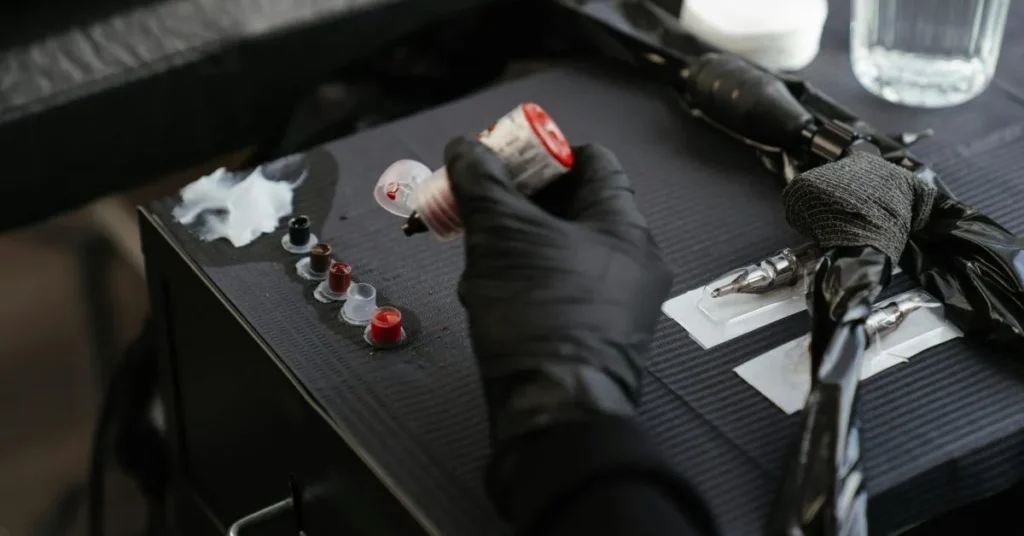

What is tattoo ink made of? Tattoo ink is made of pigments for color and a carrier solution like water, alcohol, and glycerin to keep pigments evenly suspended.
KinInk.co.kr
Tattoo ink is not simply “colored liquid.” It is a precisely engineered dispersion of pigments, solvents, and stabilizing agents designed to be deposited permanently into the dermis layer of the skin. The manufacturing process combines elements of chemistry, materials science, and strict hygiene control to ensure that the final product is both visually stable and safe for human use.
In simple terms, tattoo ink is made by finely grinding pigment particles and suspending them in a carrier solution that allows the ink to flow smoothly through tattoo needles and remain stable in the skin over time. However, the real process behind commercial tattoo ink production is far more complex, involving strict quality control, sterilization procedures, and regulatory compliance that varies by region.
This article explains exactly how tattoo ink is made, what ingredients are used, how manufacturing works step by step, and what modern safety standards govern the industry as of 2026.
Table of Contents

What Is Tattoo Ink Made Of?
Tattoo ink is typically composed of two main components:
1. Pigments (Colorants)
Pigments provide the color and are the most important element in tattoo ink. They are insoluble particles that remain suspended rather than dissolving in liquid.
Common pigment sources include:
- Organic pigments (carbon-based compounds)
- Inorganic pigments (metal oxides, mineral-based compounds)
- Synthetic pigments (laboratory-produced, designed for stability and safety)
Examples:
- Black ink: often carbon black (soot-based pigment)
- White ink: titanium dioxide
- Red ink: azo pigments or iron oxide-based compounds
- Blue/green: copper phthalocyanine derivatives
Modern manufacturers increasingly prefer synthetic organic pigments because they offer better color stability and lower contamination risk compared to older heavy-metal-based formulations.
2. Carrier Solution (Liquid Base)
The carrier is the liquid that transports pigment into the skin and keeps it evenly suspended.
Typical carrier ingredients include:
- Distilled water
- Ethanol or isopropyl alcohol (antimicrobial function)
- Glycerin (stabilizer and texture enhancer)
- Witch hazel (historically used for skin soothing)
- Propylene glycol (improves pigment dispersion)
The carrier also helps maintain sterility and prevents microbial growth inside the ink bottle.
How Tattoo Ink Is Manufactured: Step-by-Step Process
The production of tattoo ink is highly controlled and typically takes place in specialized clean facilities.
Step 1: Pigment Selection and Testing
Manufacturers begin by selecting pigment powders that meet safety and performance criteria.
Each pigment batch is tested for:
- Heavy metal contamination
- Particle size consistency
- Chemical stability
- Photostability (resistance to fading under UV exposure)
Only pigments that pass regulatory thresholds are used.
Step 2: Pigment Milling (Grinding Process)
Pigments are ground into ultra-fine particles using high-energy milling equipment.
This step is critical because:
- Smaller particles ensure smoother application
- Fine dispersion reduces clogging in tattoo needles
- Uniform particle size improves color consistency in skin
Advanced mills such as ball mills or bead mills are used to achieve micron or sub-micron particle sizes.
Step 3: Dispersion Into Carrier Solution
Once pigments are refined, they are slowly blended into the carrier liquid.
This process requires:
- High-speed mixing systems
- Controlled temperature conditions
- Anti-clumping agents to prevent pigment aggregation
At this stage, the ink begins to take its final form but is still not sterile.
Step 4: Homogenization
Homogenization ensures even distribution of pigment particles throughout the liquid.
Industrial homogenizers apply:
- High pressure
- Ultrasonic vibration or mechanical shear forces
The goal is to eliminate pigment clumps and ensure consistent flow behavior during tattooing.
Step 5: Filtration and Refinement
The ink is passed through fine filtration systems to remove impurities and oversized particles.
This step improves:
- Smoothness during application
- Safety by removing contaminants
- Predictable healing outcomes in skin
Step 6: Sterilization
Sterilization is one of the most critical safety steps.
Most modern manufacturers use:
- Gamma radiation sterilization
- Electron beam sterilization (E-beam)
- Aseptic filling in sterile environments
This ensures the final product is free from bacteria, fungi, and spores.
Step 7: Quality Control Testing
Before bottling, each batch is tested for:
- Microbial contamination
- Chemical composition consistency
- Viscosity and flow rate
- pH balance
- Pigment stability
Many manufacturers also conduct accelerated aging tests to simulate long-term skin performance.
Step 8: Bottling and Packaging
Ink is filled into sterile containers in controlled cleanrooms.
Packaging is designed to:
- Prevent contamination
- Block UV exposure
- Maintain chemical stability over time
Each bottle is labeled with batch numbers for traceability.
Safety Standards in Tattoo Ink Manufacturing (2026 Update)
Tattoo ink safety has become a major regulatory focus worldwide due to increasing awareness of long-term skin exposure and pigment migration.
European Union (REACH Regulation)
The EU’s REACH framework is currently one of the strictest regulatory systems for tattoo ink.
Key restrictions include:
- Limits on hazardous pigments
- Ban on certain azo dyes that can break down into carcinogenic compounds
- Strict heavy metal thresholds
- Mandatory ingredient disclosure
Manufacturers must reformulate many traditional inks to comply with these rules.
United States (FDA Oversight)
In the U.S., tattoo inks are regulated more loosely, but the FDA still oversees:
- Color additives (must be approved for safety)
- Contamination risks
- Adverse event monitoring
However, tattoo ink is not pre-approved like pharmaceuticals, meaning responsibility largely falls on manufacturers.
Microbiological Safety Standards
Globally, modern tattoo inks must meet:
- Sterility standards similar to medical-grade topical products
- Absence of pathogenic bacteria (e.g., Pseudomonas, Staphylococcus)
- Endotoxin control limits
Heavy Metal and Toxicity Concerns
Historically, tattoo inks sometimes contained:
- Lead
- Mercury
- Cadmium
- Chromium
Modern formulations largely avoid or tightly restrict these substances due to toxicity concerns and skin accumulation risks.
How Tattoo Ink Behaves in the Skin
Understanding manufacturing is incomplete without understanding what happens after application.
When tattoo ink is injected into the dermis:
- Pigment particles are too large for the body to fully remove
- Immune cells (macrophages) absorb some pigment
- Remaining particles stay trapped in skin tissue
- Over time, ink may fade due to:
- UV exposure
- Immune system activity
- Pigment breakdown
This is why ink formulation quality directly affects long-term tattoo appearance.
Common Additives in Modern Tattoo Ink
Advanced ink formulations may include:
- Stabilizers (to prevent separation)
- Surfactants (improve pigment suspension)
- pH buffers (maintain skin compatibility)
- Anti-settling agents (prevent sedimentation in bottles)
These additives are carefully selected to avoid skin irritation while maintaining performance.
Real-World Manufacturing Challenges
From an industry perspective, tattoo ink production faces several challenges:
1. Color Consistency
Even small variations in pigment batches can alter final tattoo appearance.
2. Regulatory Fragmentation
Different countries enforce different ingredient restrictions, requiring region-specific formulations.
3. Sterility Maintenance
Because inks are used on open skin, contamination control is critical.
4. Long-Term Stability
Ink must remain chemically stable for years without separation or degradation.
Are All Tattoo Inks Safe?
Not all tattoo inks are equal in safety or quality.
High-quality inks:
- Use tested pigments
- Follow sterilization protocols
- Comply with REACH or similar standards
- Provide full ingredient transparency
Lower-quality or unregulated inks may carry:
- Contamination risks
- Inconsistent pigment behavior
- Higher likelihood of allergic reactions
This is why professional tattoo studios typically rely on certified, regulated ink suppliers.
Future Trends in Tattoo Ink Manufacturing
By 2026, the industry is moving toward:
- Bio-safe pigment development
- Vegan-certified formulations
- Nanoparticle-controlled pigment systems
- Increased regulatory harmonization globally
- Improved fade-resistant synthetic pigments
Research is also exploring removable tattoo inks, which respond to laser wavelengths for easier removal.
Conclusion
Tattoo ink is a scientifically engineered product created through precise pigment processing, sterile manufacturing, and strict quality control systems. It is far more complex than simple colored liquid—it is a carefully designed suspension that must perform consistently in both the tattoo machine and the human dermis.
Modern manufacturing emphasizes safety, biocompatibility, and regulatory compliance, especially under EU REACH and global hygiene standards. As the industry evolves, tattoo inks are becoming cleaner, safer, and more scientifically refined than ever before.
For anyone considering tattoos or working in the industry, understanding how tattoo ink is made is essential to appreciating both its artistry and its scientific foundation.
FAQs
What are the main ingredients in tattoo ink?
Tattoo ink is primarily made of pigments (which provide color) and a carrier solution (which keeps the pigment evenly suspended). Common carriers include distilled water, alcohol, glycerin, and stabilizers, while pigments may be carbon-based (black), titanium dioxide (white), or synthetic organic compounds for color stability.
Is tattoo ink safe for the skin?
High-quality tattoo inks produced under strict safety standards are generally considered safe for dermal use. However, safety depends on:
Pigment purity (low heavy metal content)
Sterility of the ink
Manufacturing compliance (e.g., EU REACH standards)
Low-quality or unregulated inks may increase risks of allergic reactions or contamination.
How is tattoo ink sterilized during manufacturing?
Modern tattoo ink is sterilized using advanced methods such as:
Gamma radiation
Electron beam (E-beam) sterilization
Aseptic filling in cleanroom environments
These processes eliminate bacteria, fungi, and other microorganisms without altering pigment quality.
Why do tattoo inks fade over time?
Tattoo ink fades due to a combination of factors:
UV exposure breaking down pigments
Immune system cells gradually absorbing pigment particles
Natural skin regeneration
Quality of pigment formulation and particle size
Higher-quality inks with stable pigments tend to fade more slowly.
Are there heavy metals in tattoo ink?
Some older or low-quality inks may contain trace heavy metals like lead, cadmium, or chromium. However, modern regulated inks in markets like the EU and U.S. are required to limit or eliminate harmful heavy metals to meet safety standards such as REACH guidelines.

