
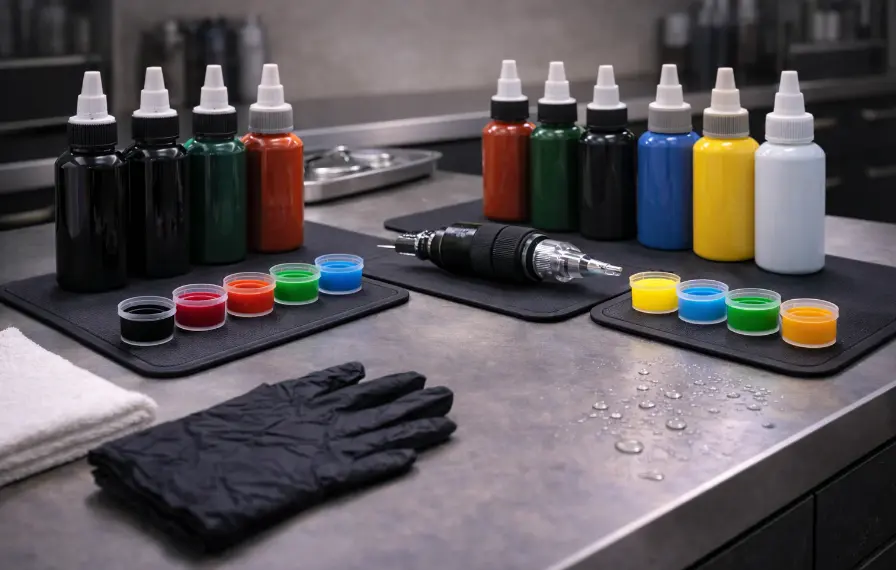

When choosing tattoo ink, tattooists should check seven key factors: microbiological safety, intended use, ingredient transparency, color consistency, viscosity and flow, batch traceability, and packaging integrity. Evaluating these factors helps professionals select tattoo ink with predictable performance, appropriate quality controls, and reliable documentation rather than choosing solely by color or popularity.
KinInk.co.kr
Choosing tattoo ink is not simply a matter of picking the strongest black, the brightest red, or the brand with the most popular color palette. For professional tattooists, ink selection is a product-safety, consistency, performance, and traceability decision.
The seven most important factors to evaluate are microbiological safety, intended-use compliance, ingredient and pigment transparency, color consistency, viscosity and flow, batch traceability and quality control, and storage and packaging integrity. These factors matter because tattoo ink is introduced into the dermal layer of the skin, meaning a problem with the product can have consequences beyond poor artistic performance. The U.S. FDA has specifically documented infections associated with contaminated tattoo inks, including contamination found in sealed bottles.
For tattooists, the best ink is therefore not necessarily the one that produces the most dramatic result in a single session. It is the one that provides predictable performance while meeting appropriate safety and quality expectations from production through application.
Table of Contents

1. Check Microbiological Safety First
The first question should be simple:
How does the manufacturer control microbial contamination?
Tattooing breaks the skin barrier and deposits ink into the skin. This makes microbial contamination fundamentally different from contamination in many ordinary cosmetic products.
The FDA’s 2024 final guidance for tattoo-ink manufacturers and distributors specifically addresses conditions that can introduce microorganisms into tattoo inks. The agency recommends attention to testing of inks and components, manufacturing controls, appropriate sterilization methods where applicable, and corrective measures when contamination is identified.
This is not merely theoretical. In 2025, the FDA warned about specific tattoo inks that laboratory testing found to contain pathogenic microorganisms, including Pseudomonas aeruginosa.
Earlier CDC investigations also documented outbreaks of tattoo-associated nontuberculous mycobacterial infections. In one investigation, contamination was identified in unopened tattoo ink, demonstrating that contamination can originate before an artist opens the bottle.
What should tattooists ask?
Before purchasing an ink line, consider asking the manufacturer or distributor:
- Is the finished product microbiologically tested?
- Are raw materials controlled for microbial contamination?
- What quality-control procedures are used during manufacturing?
- Is the product specifically manufactured for tattooing?
- Can the manufacturer provide relevant quality documentation?
- Does the company have a documented process for investigating complaints and recalls?
A professional tattooist should not assume that a sealed bottle is automatically safe simply because it looks clean. FDA guidance notes that contamination can occur even in unopened and sealed tattoo ink containers.
Practical takeaway: Microbiological quality should be evaluated before color intensity, price, or marketing claims.
2. Check Whether the Ink Is Actually Intended for Tattooing
Another important distinction is between a product that looks like tattoo ink and a product that is actually formulated and marketed for tattoo use.
Tattooists may encounter products described using terms such as drawing ink, pigment dispersion, artistic ink, cosmetic pigment, or industrial pigment. These terms do not automatically mean that a product is suitable for intradermal tattooing.
The FDA specifically advises consumers and tattoo professionals to use products intended for tattooing and notes that tattoo inks have a unique safety challenge because they are injected into the skin.
This distinction is particularly important when purchasing products internationally.
Why intended use matters
A pigment can perform extremely well in printing, painting, plastics, coatings, or other industrial applications without being appropriate for tattooing.
The question is therefore not simply:
“Does this pigment produce a good color?”
The more important question is:
“Has the complete ink formulation been developed, manufactured, packaged, and documented for its intended tattoo application?”
Tattooists should also pay attention to the manufacturer’s instructions regarding dilution, mixing, storage, and application.
If an ink requires dilution, the dilution procedure deserves particular attention. CDC investigations have demonstrated that nonsterile water can introduce microorganisms into tattoo ink, and dilution can also reduce the concentration of preservatives where preservatives are present.
Practical takeaway: Choose products specifically developed and labeled for tattoo applications rather than relying on pigment appearance or informal recommendations.
3. Check Pigment and Ingredient Transparency
The next factor is knowing what is actually in the bottle.
Tattoo ink is generally a mixture containing pigments and a liquid carrier, along with other components depending on the formulation. The exact composition can vary significantly between products and colors. FDA notes that numerous pigments and shades are used in tattooing and that the range continues to evolve.
Research examining tattoo inks has also demonstrated substantial pigment diversity. One study reviewing 1,416 commercial tattoo inks identified 44 distinct pigments and found that some pigments had previously been associated with allergic contact dermatitis.
This does not mean that every pigment identified in such research is unsafe. It does mean that tattooists should avoid treating every color as chemically equivalent.
What information is useful?
Depending on the market and applicable regulations, professional buyers may want access to information such as:
- Ingredient or pigment identification
- Color Index information where applicable
- Relevant safety documentation
- Manufacturing specifications
- Regulatory compliance information
- Allergen or restricted-substance information where applicable
- Batch or lot identification
For international purchasing, regulatory requirements can also differ by market.
For example, the EU has imposed restrictions on certain hazardous substances in tattoo inks and permanent makeup under REACH. ECHA states that these restrictions have applied since January 5, 2022, and the framework includes requirements relevant to ink formulators and tattoo artists.
Practical takeaway: A manufacturer that can clearly explain its ingredients, specifications, and regulatory position is easier to evaluate than a manufacturer relying primarily on marketing language.
4. Check Color Consistency, Not Just Color Intensity
A common mistake is to judge tattoo ink only by looking at the color in a fresh bottle.
Professional tattooing requires something more important:
repeatability.
A tattooist may use the same black or red pigment across dozens or hundreds of sessions. If the formulation varies substantially between batches, the artist may notice differences in saturation, tone, blending, or application behavior.
Color consistency depends on multiple technical factors, including:
- Pigment concentration
- Particle characteristics
- Dispersion quality
- Carrier composition
- Manufacturing controls
- Mixing and homogenization
- Storage conditions
- Batch-to-batch quality control
A good manufacturer should therefore have systems for controlling variation between production batches.
Why this matters in real-world work
Imagine an artist creates a series of tattoos using a particular gray wash. Six months later, the same artist receives a client requesting a continuation of the original design.
If the replacement bottle behaves differently or produces a noticeably different tone, matching the original work becomes more difficult.
The issue is not simply whether either product is “good.” The issue is whether the product is reproducible.
For professional studios, reproducibility is one of the most valuable characteristics an ink manufacturer can provide.
Practical takeaway: Evaluate whether the manufacturer demonstrates batch consistency rather than judging a product solely from a single bottle.
5. Check Viscosity and Flow Characteristics
Two inks can have similar colors but behave very differently under a tattoo machine.
This is where viscosity and flow become important.
Viscosity describes a fluid’s resistance to flow. In practical tattooing, the artist experiences this through how the ink moves, loads onto equipment, and interacts with the skin during the intended application technique.
The ideal characteristics can vary according to:
- Tattoo style
- Needle configuration
- Machine setup
- Shading technique
- Packing technique
- Artist preference
- Ink formulation
A highly fluid formulation may behave differently from a thicker formulation during color packing or shading. Neither characteristic is automatically “better” in every application.
What should be evaluated?
Rather than asking whether an ink is simply “thick” or “thin,” professional testing should consider:
- Flow consistency
- Ease of application
- Dispersion during use
- Behavior after shaking or mixing
- Settling during storage
- Consistency across colors
- Repeatability between batches
For manufacturers, this is an area where controlled formulation and quality testing can create meaningful differentiation.
For tattooists, the practical question is:
Does the ink behave predictably with my established workflow?
Practical takeaway: Choose viscosity and flow characteristics that match the artist’s technique instead of assuming one formulation works equally well for every application.
6. Check Batch Numbers, Expiration Dates, and Traceability
Traceability is one of the most overlooked aspects of professional ink selection.
Every tattooist should be able to identify which product, color, and batch was used on a client.
Why?
Because if a problem is reported later, traceability helps determine whether the issue is associated with:
- A specific product
- A specific color
- A specific lot
- A manufacturing period
- A storage condition
- A particular application procedure
FDA consumer guidance specifically recommends retaining information such as the brand, color, and lot or batch number when an adverse reaction occurs.
This means batch information is not merely administrative labeling. It can become an important part of safety investigation.
A professional studio system

A studio can establish a simple record containing:
| Information | Example |
|---|---|
| Brand | Manufacturer name |
| Product | Black pigment |
| Color | Black / specific shade |
| Lot number | Manufacturer batch |
| Expiration date | Manufacturer date |
| Date opened | Studio record |
| Artist | Responsible tattooist |
| Client record | Internal reference |
This approach can significantly improve traceability if a product complaint or recall occurs.
Practical takeaway: If a manufacturer does not provide clear batch identification and expiration information, that should be treated as a quality-management concern.
7. Check Packaging, Storage, and Manufacturer Support
Even a well-formulated ink can be compromised if packaging or storage is poorly controlled.
Tattooists should inspect bottles for:
- Damaged seals
- Leakage
- Cracked containers
- Contaminated nozzles
- Unusual changes in appearance
- Missing or unclear labeling
- Expired product
- Unusual odor or physical changes
The storage environment should also follow the manufacturer’s instructions. Temperature, light exposure, contamination during handling, and repeated opening can all affect product integrity.
But packaging is only one part of this final criterion.
A professional manufacturer should also provide responsive technical and quality support.
What does good manufacturer support look like?
A serious supplier should be able to provide clear answers about:
- Product specifications
- Batch identification
- Storage requirements
- Recommended use
- Regulatory documentation
- Quality complaints
- Recall procedures
- Product changes
- Distributor information
This becomes especially important for tattooists purchasing internationally.
A manufacturer that communicates clearly before a sale is generally easier to work with when a technical or quality issue occurs later.
Practical takeaway: Evaluate the company behind the bottle, not just the bottle itself.
A Simple Tattoo Ink Evaluation Checklist
Before adopting a new ink brand, tattooists can use this practical framework:
| Factor | What to evaluate |
| 1. Microbiological safety | Manufacturing controls, testing, contamination prevention |
| 2. Intended use | Specifically formulated and marketed for tattoo applications |
| 3. Ingredients | Pigment identity, formulation information, regulatory documentation |
| 4. Color consistency | Reproducibility and batch-to-batch consistency |
| 5. Viscosity & flow | Predictable behavior for the artist’s technique |
| 6. Traceability | Lot number, expiration date, manufacturer records |
| 7. Packaging & support | Seal integrity, storage requirements, technical support |
This framework is more useful than simply asking which tattoo ink is “the best.”
There is rarely one universal ink that is ideal for every artist, style, machine, and application. Instead, professional selection should combine safety, regulatory suitability, formulation quality, predictable performance, and traceability.
Why Manufacturer Quality Matters More Than Marketing
Tattoo ink manufacturers operate in a particularly demanding category because their products are intended to be introduced into the skin.
The FDA has repeatedly highlighted microbial contamination as an important safety concern. Its 2024 final guidance specifically focuses on preventing contamination during the preparation, packing, and holding of tattoo inks.
Recent regulatory actions reinforce why this matters. In May 2025, the FDA identified specific tattoo inks contaminated with microorganisms and advised tattoo artists and retailers not to use or sell the affected products.
The lesson for tattooists is straightforward:
Do not evaluate tattoo ink solely by color, price, popularity, or social-media reputation. Evaluate the manufacturing system behind it.
A professional manufacturer should be able to demonstrate controlled production, appropriate quality testing, reliable documentation, traceability, and a clear approach to regulatory compliance.
FAQs
What should tattooists check when choosing tattoo ink?
When choosing tattoo ink, tattooists should check microbiological safety, intended tattoo use, ingredient transparency, color consistency, viscosity, batch traceability, and packaging integrity. Tattoo ink quality should be evaluated based on documented manufacturing and quality-control practices rather than color or popularity alone.
How can tattooists evaluate tattoo ink quality?
Tattooists can evaluate tattoo ink quality by reviewing manufacturer information about ingredients, production controls, batch testing, expiration dates, storage requirements, and traceability. Consistent color, predictable flow, intact packaging, and clear product documentation are also important when comparing professional tattoo inks.
What makes tattoo ink safe for professional use?
Safe tattoo ink should be specifically manufactured and intended for tattoo applications and produced under appropriate quality and contamination-control procedures. Tattooists should also verify product labeling, batch information, expiration dates, storage instructions, and applicable regulatory requirements before using a new ink.
Why are ingredients important when choosing tattoo ink?
Ingredient transparency is important when choosing tattoo ink because different formulations can contain different pigments, carriers, and other components. Tattooists should look for clear manufacturer information and relevant regulatory documentation rather than assuming that every pigment or artistic ink is suitable for intradermal tattooing.
Why is batch traceability important for tattoo ink?
Tattoo ink selection should include checking the lot or batch number because traceability helps identify the specific product used if a quality complaint, adverse reaction, or product recall occurs. Professional studios should record the brand, color, batch number, expiration date, and other relevant product information whenever practical.
Final Takeaway
For tattooists, choosing tattoo ink should be treated as a professional product-quality decision rather than a simple color preference.
The seven factors to check are:
- Microbiological safety
- Intended use and regulatory suitability
- Pigment and ingredient transparency
- Color consistency
- Viscosity and flow
- Batch traceability
- Packaging, storage, and manufacturer support
The strongest tattoo ink manufacturers are not simply selling attractive colors. They are building systems that help artists obtain consistent, traceable, and appropriately controlled products.
For tattoo professionals, that distinction matters. A bottle of ink represents more than pigment: it is part of a process that connects manufacturing quality, artist performance, client safety, regulatory compliance, and long-term professional reliability.
As regulations and scientific understanding continue to develop, tattooists should periodically reassess their suppliers rather than assuming that a familiar brand automatically remains the best choice. A manufacturer that can provide transparent information, documented quality controls, and dependable batch traceability gives professional artists a much stronger foundation for responsible tattoo practice.
Reference
- U.S. Food and Drug Administration (FDA) — FDA Issues Final Guidance on Tattoo Inks
- U.S. Food and Drug Administration (FDA) — Think Before You Ink: Tattoo Safety
- U.S. Food and Drug Administration (FDA) — Tattoos, Temporary Tattoos & Permanent Makeup

