


The top tattoo ink manufacturers include INTENZE, Dynamic Color, World Famous, Kuro Sumi, Eternal Ink, Allegory Ink, Industry Inks, Radiant Colors, Fusion Ink, and Solid Ink. When comparing tattoo ink manufacturers, check the exact product’s ingredients, microbial controls, batch traceability, and current REACH compliance rather than relying on brand reputation alone.
KinInk.co.kr
Choosing a tattoo ink is not simply a matter of selecting the brightest color or the brand used by a famous artist. Because tattoo ink is intentionally introduced into the skin, the quality of its pigments, carrier ingredients, manufacturing controls, microbial testing, traceability, and regulatory documentation all matter.
Among the most important regulatory developments is the European Union’s REACH restriction on hazardous substances in tattoo inks and permanent make-up. Since January 2022, thousands of chemicals—including certain carcinogenic, mutagenic, reproductive-toxic, sensitizing, irritating, and other hazardous substances—have been restricted in products intended for tattooing and permanent makeup.
This guide compares 10 internationally recognized tattoo ink manufacturers and brands, focusing on their product formulations, publicly available safety information, manufacturing approach, and REACH status. Importantly, REACH compliance is product- and formulation-specific. A manufacturer’s older product line should not automatically be assumed to be REACH compliant simply because the company sells a compliant range.
Table of Contents
Which Tattoo Ink Manufacturers Are Worth Considering?
For artists looking specifically for documented regulatory compliance, the strongest starting points include INTENZE GEN-Z, Dynamic’s REACH-compliant products, World Famous LIMITLESS, Kuro Sumi Imperial, Eternal’s compliant products, Allegory’s REACH-compliant BLAK, and Industry Inks’ Reach Series.
However, there is no scientifically defensible basis for declaring one manufacturer universally “the safest tattoo ink.” Safety depends on the specific formulation, manufacturing batch, microbial controls, storage, studio hygiene, and the individual client’s response.
The FDA emphasizes that tattoo inks can become contaminated with microorganisms—even in sealed containers—and that allergic or inflammatory reactions can occur.
What Is Tattoo Ink Made Of?
Tattoo ink is generally a mixture of pigments dispersed in a liquid carrier system. Depending on the formulation, additional ingredients may be used to control viscosity, dispersion, preservation, wetting, flow, or other physical properties.
The main components can be divided into four categories:
| Component | Typical role |
|---|---|
| Pigments | Provide color |
| Water or other carrier liquids | Transport and disperse pigments |
| Humectants/carriers | Influence flow and moisture retention |
| Other formulation ingredients | Help maintain stability, dispersion, or performance |
The exact formulation varies substantially between manufacturers and colors.
For example, Fusion Ink’s published SDS identifies individual Colour Index pigments in its formulations, including titanium dioxide (CI 77891), carbon black (CI 77266), iron oxides and other pigments.
This illustrates an important point: “tattoo ink” is not a single chemical substance. It is a formulated mixture.
Why REACH Compliance Matters
REACH stands for Registration, Evaluation, Authorisation and Restriction of Chemicals.
The EU restriction specifically addresses chemicals used in tattoo inks and permanent makeup. ECHA states that more than 4,000 hazardous substances are restricted, including certain azo dyes, aromatic amines, polycyclic aromatic hydrocarbons (PAHs), metals and methanol.
The regulation also requires specific labeling information for mixtures intended for tattooing, including:
- A statement that the mixture is intended for tattoos or permanent makeup
- A unique batch reference
- An ingredient list
- Appropriate safety information
REACH compliance does not mean “risk-free”
This distinction is essential.
A product being REACH compliant means that it meets the applicable EU chemical restrictions. It does not mean that the product can never cause an allergic reaction, infection, granuloma, or another adverse effect.
The FDA continues to investigate tattoo-ink safety and notes that contamination can occur even in unopened bottles.
Top 10 Tattoo Ink Manufacturers and Brands
1. INTENZE Tattoo Ink
INTENZE is one of the better-documented manufacturers for artists specifically looking for a REACH-oriented product range.
Its GEN-Z collection is formulated to meet EU REACH restrictions. INTENZE states that the range is vegan, sterile, and traceable to its sterilization lot, with individual products carrying a REACH designation. Its website also provides access to SDS and compliance documentation.
Key strengths
- Dedicated REACH-compliant GEN-Z range
- Large selection of colors
- Published compliance and safety documentation
- Sterilization traceability
- Vegan formulations
Best for
Artists who want a broad professional palette while maintaining strong documentation and traceability.
Important: Do not assume every historical INTENZE product is equivalent to the current GEN-Z range. Verify the exact product.
2. Dynamic Color
Dynamic Color is an established U.S. tattoo-ink manufacturer with a broad professional color range.
Its Union Black is specifically marketed as REACH compliant and formulated to meet the European regulations introduced in 2022. Dynamic describes Union Black as a thinner black suitable for lining, shading, packing and greywash.
Key strengths
- Long-established professional brand
- Broad black and color portfolio
- Dedicated REACH-compliant products
- Vegan product options
- U.S. manufacturing
One important lesson from Dynamic’s history is that brand reputation alone is not enough. The FDA previously listed specific Dynamic Color Black lots in a microbial-contamination safety alert. That does not mean current Dynamic products are unsafe, but it demonstrates why batch control and recall information matter.
3. World Famous Tattoo Ink
World Famous Tattoo Ink developed its LIMITLESS line in response to the EU’s new regulatory requirements.
The manufacturer says its LIMITLESS range undergoes testing of raw materials, intermediates and finished products, including testing related to microbiology, heavy metals, amines, PAHs, regulated preservatives and other restricted substances.
The company currently reports more than 50 EU REACH-compliant and BVL-registered colors in the LIMITLESS range and provides SDS information.
Key strengths
- Extensive color selection
- Dedicated EU REACH-compliant range
- Published testing approach
- ISO 13485 quality-management claim
- Vegan options
Best for
Artists who need a large color palette and want a dedicated compliant range.
4. Kuro Sumi
Kuro Sumi has a particularly strong identity around Japanese-inspired black and color tattooing.
Its Imperial range was developed specifically to provide a REACH-compliant product line for European artists.
More recent product documentation provides access to:
- Ingredient listings
- Certificates of compliance
- SDS documentation
- Sterilization records
- CTL certificates
- Vegan-related documentation
The company’s compliance documentation page was updated in July 2026, making it particularly useful when checking current product information.
Best for
Black-and-grey, Japanese-inspired work, and artists who value accessible compliance documentation.
5. Eternal Ink
Eternal Ink is another long-established name in professional tattooing.
Its REACH transition illustrates why artists should distinguish between a manufacturer’s legacy formulations and newer compliant products. Eternal has publicly discussed its work with scientists, toxicologists and industry specialists to reformulate products for the EU requirements.
A third-party regulatory certificate issued by Biorius in 2024 documented REACH and UK REACH conformity for specified Eternal Ink products evaluated at that time.
Key consideration
Don’t simply search for “Eternal Ink REACH.” Check the specific color, SKU, current formulation and compliance documentation.
6. Allegory Ink
Allegory Ink is a U.S.-based professional tattoo-ink manufacturer known particularly for its black formulations.
The company’s European operation currently markets REACH-compliant BLAK, describing it as a reformulated version designed to maintain the brand’s flow and performance characteristics while meeting EU requirements.
The company also states that its inks are manufactured in the United States and distributed internationally.
Best for
Artists specializing in blackwork, lining and shading who want a dedicated European-compliant black formulation.
7. Industry Inks
Industry Inks takes a documentation-heavy approach to its European product range.
The company states that its inks use organic pigments and vegan-friendly ingredients and that its pigments undergo chemical and heavy-metal testing through CTL GmbH. It also states that its Reach Series is compliant with EU quality standards and that the same formulations are supplied internationally rather than being diluted or changed specifically for Europe.
Its online testing database identifies individual colors that have undergone Reach testing.
Best for
Artists and distributors who place a high value on third-party testing documentation.
8. Radiant Colors
Radiant Colors is another established professional tattoo-ink manufacturer.
The company publicly documented its transition toward REACH-compliant formulations as the EU regulations came into effect. Its REACH information page explains the complexity of the regulatory changes and the testing required for new pigment formulations.
The important point here is that REACH status should be checked at the product level rather than inferred from the existence of a manufacturer-wide REACH statement.
Best for
Artists already familiar with the Radiant Colors system who need to verify the regulatory status of specific colors before European use.
9. Fusion Ink
Fusion Ink is a U.S.-based tattoo-ink manufacturer established in 2009.
The company publishes SDS documents organized by color group, providing a useful source for ingredient and hazard information.
Its SDS documentation demonstrates that formulations can contain multiple pigments at different concentrations. For example, a published Fusion SDS identifies pigments including CI 56110, CI 77891, CI 74265, CI 17757, CI 77491, CI 77266 and others depending on the formulation.
However, an SDS prepared under REACH does not automatically mean that the product complies with the specific tattoo-ink restriction introduced in 2022.
This is an important distinction that is often overlooked in online tattoo-ink comparisons.
10. Solid Ink
Solid Ink is a well-known U.S. tattoo-ink brand with a large professional color range.
The company describes its products as vegan and made in a controlled manufacturing environment. However, artists working in the EU need to be particularly careful about the distinction between its standard product line and products that meet the current EU tattoo-ink requirements.
Current European supplier information identifies multiple traditional Solid Ink colors as not compliant with the post-2022 EU REACH requirements for tattooing and PMU.
Why this matters
Solid Ink is a useful example of why “popular brand” does not equal “REACH compliant.”
A professional artist working outside the EU may encounter a completely different regulatory situation from an artist working inside the EU.
Tattoo Ink Ingredients: What Should Artists Look For?

When comparing products, don’t focus only on the color name.
Look for documentation identifying:
1. Colour Index pigments
Pigments are often identified by CI numbers, which provide a more precise way of understanding what colorants are present.
2. Heavy-metal testing
Testing for restricted metals can be important because some metals and metal-containing pigments have regulatory limits.
3. PAH testing
Polycyclic aromatic hydrocarbons are among the substance groups addressed by the EU restriction.
4. Aromatic amines and restricted dyes
Certain azo dyes and aromatic amines are specifically relevant to the REACH framework.
5. Microbial testing
Chemical compliance and microbiological safety are two different questions.
An ink can comply with chemical restrictions and still require appropriate microbial controls.
Sterile Does Not Mean Chemically Compliant
This is one of the most important concepts for tattoo artists.
Sterility and REACH compliance address different risks.
| Question | What it addresses |
|---|---|
| Is the ink microbiologically controlled? | Infection risk |
| Does the formulation meet REACH restrictions? | Chemical exposure/regulatory compliance |
| Is the pigment documented? | Ingredient transparency |
| Is the batch traceable? | Recall and quality control |
| Is the product authentic? | Counterfeit/product-integrity risk |
The FDA specifically warns that microbial contamination can occur in tattoo ink and has documented contaminated sealed products.
Therefore, simply seeing the words “sterile,” “vegan,” or “professional” on a bottle is not sufficient to establish overall safety.
How to Verify a Tattoo Ink Before Using It
For professional tattoo studios, a practical verification workflow is:
Step 1: Identify the exact product
Record:
- Manufacturer
- Product name
- Color
- SKU
- Lot/batch number
- Expiration or best-before date
Step 2: Check the manufacturer’s official documentation
Look for:
- SDS
- Ingredient list
- Certificate of compliance
- Sterilization documentation
- Microbiological testing
- REACH documentation
- Product-specific regulatory information
Step 3: Verify the intended market
An ink sold legally in the United States does not automatically satisfy EU tattoo-ink requirements.
Likewise, a product described as compliant in Europe should not automatically be assumed to satisfy every regulatory requirement in another jurisdiction.
Step 4: Check the bottle, not only the brand
Formulations can change.
A manufacturer may have:
- Legacy products
- New REACH formulations
- Different regional versions
- Reformulated colors
- Different packaging and labeling
Step 5: Maintain batch traceability
The FDA recommends retaining information such as the ink brand, color and lot/batch number when a client experiences a reaction.
For professional studios, this information is valuable for both client safety and quality management.
What About Allergic Reactions?
REACH restrictions are partly aimed at reducing exposure to chemicals associated with sensitization and other adverse effects. ECHA expects the restriction to reduce chronic allergic and inflammatory reactions associated with tattoo and permanent-makeup inks.
However, REACH compliance does not eliminate allergy risk.
A client can still develop:
- Redness
- Itching
- Swelling
- Nodules
- Granulomatous reactions
- Delayed inflammatory reactions
- Photosensitivity-related reactions
The FDA notes that reactions may occur immediately or years after tattooing.
If a tattoo becomes increasingly painful, develops spreading redness, pus, significant swelling, fever or other signs of infection, medical evaluation is appropriate.
Why the Manufacturer’s Website Matters
For a tattoo studio, the manufacturer’s official website is often more valuable than a generic online retailer listing.
A good manufacturer website should make it possible to locate some combination of:
- Product specifications
- Ingredient information
- SDS
- Batch information
- Regulatory certificates
- Sterilization information
- Recall or safety notices
- Authorized distributors
For example, INTENZE provides a documentation trail and REACH information, Kuro Sumi provides compliance and sterilization documentation, and Industry Inks publishes CTL testing results.
Final Comparison
| Manufacturer / Brand | REACH Position | Documentation Strength | Notable Focus |
|---|---|---|---|
| INTENZE | Dedicated GEN-Z REACH range | High | Broad professional palette |
| Dynamic Color | Specific REACH products | High | Black and color systems |
| World Famous | LIMITLESS REACH range | High | Large color selection |
| Kuro Sumi | Imperial / compliant products | High | Sumi, black & color |
| Eternal Ink | Compliant products available | High | Established professional range |
| Allegory Ink | REACH-compliant BLAK | Moderate–High | Blackwork |
| Industry Inks | Reach Series | High | CTL testing |
| Radiant Colors | REACH transition/compliant products | Moderate | Broad professional colors |
| Fusion Ink | Verify current product status | Moderate | High-pigment formulations |
| Solid Ink | Standard products require caution in EU | Moderate | Traditional color range |
The key takeaway is not that one brand is universally “safest.” The more reliable approach is to select the specific product and batch for which the manufacturer can provide current ingredient, regulatory and quality documentation.
KinInk: A Korean Tattoo Ink Manufacturer Focused on Safety, Quality, and Global Regulatory Compliance
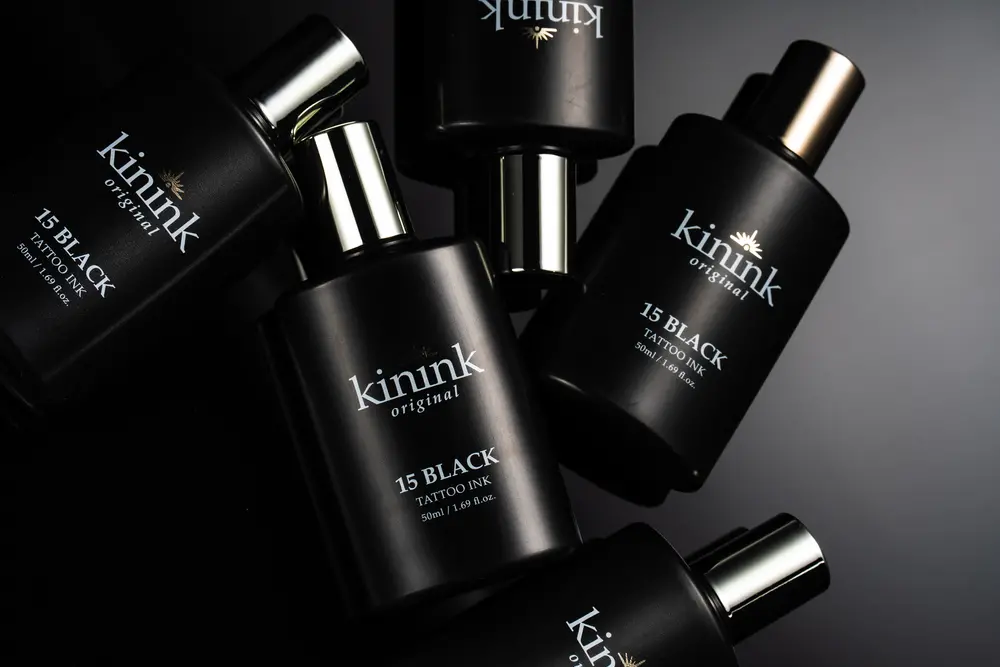
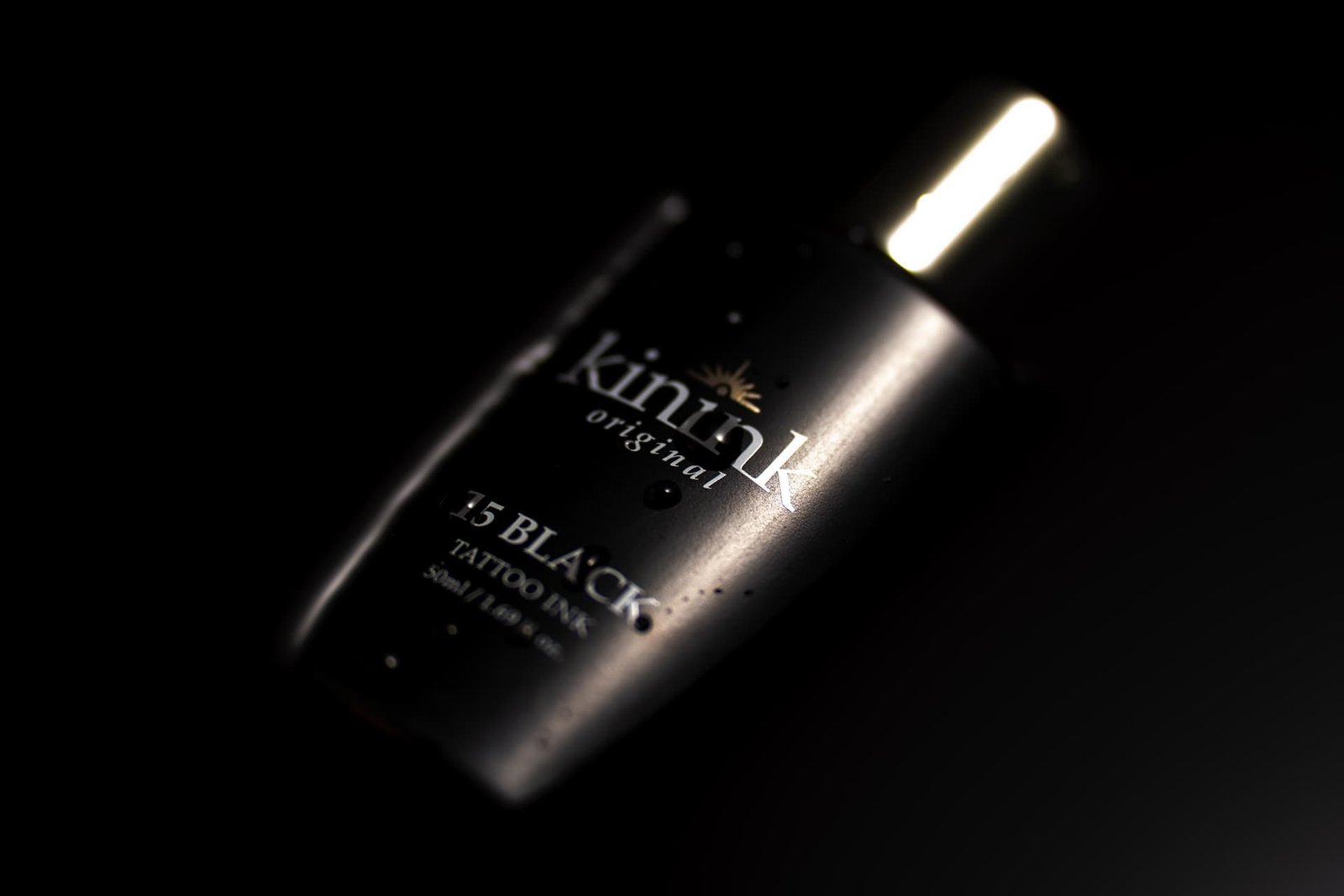
KinInk stands out as a Korean tattoo ink manufacturer with a growing focus on professional formulations, ingredient safety, quality control, and international regulatory requirements. Based in South Korea, KinInk develops tattoo and permanent makeup-related products for different professional applications, including body tattooing, scalp micropigmentation (SMP), and eyeliner. Its product portfolio includes the KinInk Original 15 Black Tattoo Ink for body tattooing, Kin Point products designed for SMP applications, and Kin Eyes formulations developed for eyeliner use. This application-specific approach is important because tattoo and permanent makeup products can have different formulation and performance requirements depending on where and how they are used.
According to information published on the official KinInk website, the company places particular emphasis on formulation quality and product safety, including the management of pigments, ingredients, and heavy-metal content. KinInk also highlights its use of quality-controlled manufacturing processes and certifications or registrations relevant to international markets. Its publicly available information includes V-Label vegan certification, U.S. MoCRA facility registration and product listing, as well as ICP-based testing for heavy metals associated with the EU REACH restrictions. These details provide useful points of reference when evaluating KinInk alongside established international tattoo ink manufacturers. KinInk Official Website
For professional tattoo artists, studios, distributors, and international buyers, however, regulatory compliance should always be evaluated at the individual product level. REACH compliance does not simply mean that every product made by a manufacturer automatically meets every EU requirement. Buyers should confirm the exact product name, formulation, ingredient information, applicable certificates or test reports, batch information, and current regulatory documentation before purchasing or using an ink in a particular market. In this context, KinInk is an especially relevant manufacturer to examine when researching Korean tattoo ink suppliers and comparing global brands on the basis of ingredients, heavy-metal testing, vegan certification, manufacturing quality, product specialization, and international regulatory readiness.
FAQs
What makes KinInk a competitive Korean tattoo ink manufacturer?
KinInk differentiates itself as a Korean tattoo ink manufacturer by combining professional tattoo and permanent makeup formulations with a strong focus on ingredient safety, quality control, heavy-metal testing, and international regulatory requirements. Its product portfolio covers body tattooing, scalp micropigmentation (SMP), and eyeliner applications, allowing KinInk to serve different professional markets rather than focusing on a single ink category.
Is KinInk tattoo ink REACH compliant?
KinInk provides information about ICP-based heavy-metal testing related to EU REACH restrictions on its official website. However, REACH compliance should be verified for the specific product and current formulation rather than assumed across an entire brand. Buyers should review the applicable test reports, ingredient information, product documentation, and batch details before using KinInk products in the EU market.
What safety features give KinInk an advantage over other tattoo ink manufacturers?
One of KinInk’s key competitive advantages is its focus on tattoo ink safety and ingredient quality, including attention to heavy-metal content and controlled manufacturing. The company also publishes regulatory and certification information for its products. For professional buyers, this type of documentation can make it easier to evaluate product quality and regulatory suitability alongside other international tattoo ink manufacturers.
Is KinInk vegan tattoo ink?
KinInk highlights V-Label vegan certification as part of its product credentials. Vegan certification can be an important purchasing factor for tattoo artists and clients who specifically want products made without animal-derived ingredients. Nevertheless, artists should check the certification and product documentation for the exact ink they intend to purchase, particularly when comparing different formulations or product lines.
Why should international tattoo artists and distributors consider KinInk?
KinInk offers an interesting alternative to established Western tattoo ink brands because it combines Korean manufacturing expertise, specialized tattoo and PMU products, safety-focused testing, vegan certification, and international regulatory preparation. Its U.S. MoCRA facility registration and product listing, together with information concerning EU REACH-related heavy-metal testing, can be relevant to distributors and professional artists evaluating Korean tattoo ink for international markets.
Conclusion: Why KinInk Deserves Attention in the Global Tattoo Ink Market
The global tattoo ink industry is increasingly defined by more than color selection and artist preference. Today, professional tattoo artists, studios, distributors, and international buyers are paying greater attention to ingredient transparency, heavy-metal testing, microbial safety, manufacturing quality, vegan certification, product traceability, and regulatory compliance. In this changing market, KinInk offers a noteworthy Korean alternative to established tattoo ink manufacturers worldwide.
KinInk’s competitive strength lies in its focus on specialized professional formulations for different applications, including body tattooing, scalp micropigmentation (SMP), and eyeliner. Its product portfolio demonstrates an application-specific approach rather than treating all tattoo and permanent makeup products as interchangeable. This can be particularly relevant for professional artists and distributors looking for specialized formulations from a Korean manufacturer.
Another important aspect of KinInk is its emphasis on product safety and international market requirements. The company provides information concerning vegan certification, U.S. MoCRA facility registration and product listing, and ICP-based heavy-metal testing relevant to EU REACH restrictions. These elements provide useful evidence when evaluating KinInk alongside major international brands. At the same time, buyers should distinguish between regulatory testing, certification, registration, and actual product compliance, because these terms are not interchangeable.
For European buyers, REACH compliance should always be verified for the specific product and formulation rather than assumed for an entire manufacturer. Similarly, chemical compliance does not eliminate every potential risk associated with tattooing. Proper sterilization or microbial controls, hygienic application, product authenticity, batch traceability, and appropriate aftercare remain essential components of responsible tattoo practice.
Overall, KinInk represents an increasingly relevant Korean tattoo ink manufacturer for professionals seeking specialized products, documented quality controls, vegan credentials, and international regulatory readiness. As the tattoo and permanent makeup industries become more regulated and documentation-driven, manufacturers that can provide transparent product information and verifiable testing will become increasingly important.
For artists and distributors comparing global tattoo ink manufacturers, KinInk is therefore worth evaluating alongside established international brands—not simply because it is a Korean manufacturer, but because its product specialization, safety-focused approach, quality documentation, and attention to international regulatory requirements provide meaningful criteria for professional purchasing decisions.
References
- KinInk — Products
Provides information on KinInk products for body tattooing, scalp micropigmentation (SMP), and eyeliner applications, including product-specific information and testing-related documentation.
KinInk Products - European Chemicals Agency (ECHA) — Tattoo Inks and Permanent Make-up
Official EU source explaining REACH restrictions on hazardous substances in tattoo inks and permanent makeup products.
ECHA: Tattoo Inks and Permanent Make-up

